
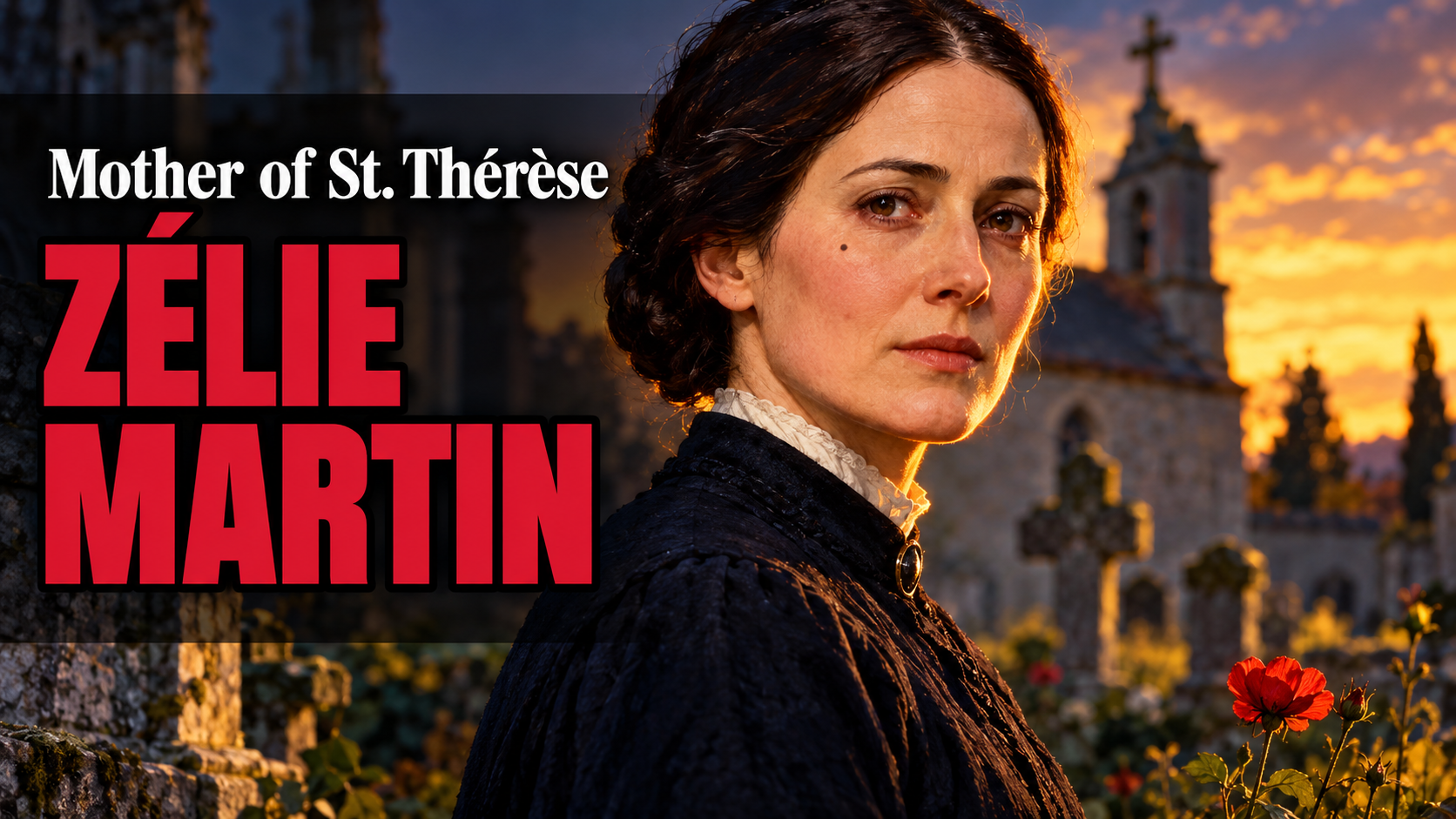
If you have ever buried someone you would have died for, you already know this woman. Saint Zélie Martin buried four of her children: two baby boys, a daughter of five, and a girl not yet two months old. Four small graves in less than four years.
A year after the last burial, her sister-in-law lost a newborn son, and Zélie wrote to comfort her. That letter survives. In it she says: “When I closed my dear little children’s eyes and buried them, I felt a lot of pain, but it was always resigned.”
Resigned. It can sound like a woman who simply stopped feeling. Her other letters show that it meant something very different, and what it cost her. They also answer the question every parent who has lost a child is really asking: how does faith survive the fourth grave?

What the Church Said About Her
Start with the Church’s own words. On October 18, 2015, Pope Francis canonized Zélie in St. Peter’s Square together with her husband, Louis. They were the first married couple in the history of the Church to be canonized together as spouses. The canonization took place during the Synod of Bishops on the Family, seven years after Pope Benedict XVI beatified them in 2008.
In his homily that day, Pope Francis did not hold up a miracle or a mystical experience. He held up a household. The holy spouses, he said, “practised Christian service in the family, creating day by day an environment of faith and love.”
Day by day. In that house, some of those days were funerals.

Who Was Zélie Before the Graves?
Zélie Guérin was born on December 23, 1831, in Gandelain, in the Orne region of Normandy. In April 1858 she met Louis Martin, and three months later, in July, they were married in Alençon. She was 26.
Nine children followed between 1860 and 1873. Five were daughters who lived to grow up, and all five became religious sisters. The youngest of them is St. Thérèse of Lisieux. The other four children never grew up at all: Hélène, Joseph-Louis, Joseph-Jean-Baptiste and Mélanie-Thérèse. The Carmel of Lisieux keeps their records under a gentle heading, “the little children of heaven.”
Around 1865, Zélie noticed a lump in her right breast. She took it for an old bruise, and for years it seemed not to change. It was there before the first funeral, and it would still be there after the last one.

Two Sons in Eighteen Months
The first to die was a boy, Joseph-Louis, the couple’s first son. He was born on September 20, 1866, and lived four months and twenty-five days, dying on February 14, 1867. Zélie was 35. The sources used here do not say what took him; only his two dates survive.
Ten months later another boy was born, and they gave him the name Joseph again: Joseph-Jean-Baptiste, born December 19, 1867. In May 1868 he caught bronchitis, and it held him all summer. By late August he was failing; for five days, Zélie wrote, he had been unable to keep anything down. He died at seven in the morning on August 24, 1868, at eight months old. That same day she wrote to her brother Isidore. By the Carmel archive’s account of that letter, she was alone with him.
Two sons buried in eighteen months, both of them named Joseph. Two months later, she was writing to her brother again. That is where her holiness first shows: in the next letter, written to the living.
What a Saint’s Grief Sounds Like
Still in the house was Hélène, born in October 1864. By the winter of 1870 she was five. A bout of measles had left her with a lingering trouble in her eye, and then came what the family’s letters call a mucous fever, with congestion in her lungs. She died on February 22, 1870, at five years and four months old. By the archive’s account, her head fell onto her mother’s shoulder, her eyes closed, and five minutes later she was gone.
Two days later Zélie wrote that she had been blind not to notice how the little girl was declining. If you have ever replayed the last weeks, looking for the thing you missed, a saint has done exactly that, in ink.
A month later, on March 27, she wrote to her sister-in-law:
“I grieved my two little boys, but I feel even more sorrow at losing this one.”
She had only begun, she wrote, to really enjoy her: so sweet, so affectionate, so far ahead for her age. And then:
“Not a minute of the day goes by that I don’t think of her.”
So that is what “resigned” meant for Zélie. The pain stayed, every minute of every day, and she still bowed to God’s will. In the same letter she admits a burning desire to see her daughter again. Then she turns: those who remain, she writes, need her.
This is where saints like Zélie get flattened. The holy-card version is serene. Her letters are not. They name the grief, and even rank it. Her faith kept turning her back toward the four daughters still living, with the grief walking beside her the whole way.
The Baby Born After Hélène
When Hélène died, Zélie was already carrying another child. On August 16, 1870, a daughter was born, Marie-Mélanie-Thérèse, small but lively and gentle, the letters say. By her third day she had stomach troubles and was placed with a wet nurse in Alençon. It is tempting to blame the nurse, but the sources used here do not support that. They show a sick newborn and a placement.
She died on Saturday, October 8, 1870, at one in the afternoon, not yet eight weeks old. The baby had suffered terribly in her final hours, Zélie wrote. She was desolate; she had loved this child so much. Zélie was 38.
Four children buried between February 1867 and October 1870: three years and eight months.
What She Had Been Carrying the Whole Time
In 1873 her last child was born, a daughter. They named her Thérèse, the same name as the baby they had lost. That November, on All Saints’ Day, Zélie wrote to her two eldest daughters, Marie and Pauline, the line that later became famous: “I want to become a saint. Better late than never.” It would not be easy, she added. There was a lot of chopping to do, and the wood was as hard as stone. A mother who had buried four children was calling herself late, and picking up the axe anyway.
In 1876 the lump began to hurt. A doctor confirmed it was cancer and said nothing could be done, and by December it was far advanced. It had been there about eleven years: before Joseph-Louis died, when Hélène died, at all four graves.
.jpg?width=1400)
In June 1877 she traveled to Lourdes with her three eldest daughters to pray for a cure. There was no cure. After the journey home she grew worse. She had asked, and the answer she received was not healing.
Lines said to be from her last letters circulate widely online. None of them could be matched to the Carmel of Lisieux archive, so none are quoted here.
Zélie Martin died in Alençon on August 28, 1877, at 45. Her youngest, Thérèse, was four. Louis was left alone with five daughters, the eldest still in her teens.
So What Made Her a Saint?
Go back to that letter to her sister-in-law. In it, Zélie repeats what some people had told her about her four children, the cruelest thing you can say to a grieving parent: that it would have been better never to have had them at all. Her answer:
“I did not regret the sorrows and worries I had endured for them.”
Sorrows and worries, she wrote, could not be weighed against the eternal happiness of her children. That was her whole answer.
A personal reading, not a Church ruling: she did not become a saint in spite of four graves, but beside them, day by day, which is exactly what Pope Francis praised.

One Thing to Do This Week
For seven nights, write a few lines to God about the person you lost, by name. Write what still hurts. Don’t tidy it up; her letters never did. Then offer the page as it is.
If you carry a name tonight, whether a child, a parent or a friend, leave it in the comments so others can pray for them too.
Four names she never stopped saying. Not a minute of the day. That is what holiness looked like in her house.
Go deeper
If stories like this one stay with you, there are fifty more in 50 Saints: Stories and Prayers for Divine Intervention — fifty lives from across the history of the Church, each paired with a prayer. Find it in the Catholic Journey shop.
Read Zélie in her own words: A Call to a Deeper Love, the family’s own letters, several of them quoted in this article. As an Amazon Associate I earn from qualifying purchases.
Sources
- Tier 1: Pope Francis, homily for the canonization of Louis and Zélie Martin, October 18, 2015, and the Angelus of the same day.
- Tier 2: Archives of the Carmel of Lisieux, Zélie Martin and “Les petits enfants du ciel”: dates for Zélie and the four children, and the family correspondence (CF 54, March 27, 1870; CF 72, October 17, 1871; CF 110, November 1, 1873). Quotations are English renderings of the French letters; some details, such as Hélène’s last moments and the letter to Isidore, follow the archive’s summaries rather than the letters’ exact wording.
- Tier 3: Sanctuary of Louis and Zélie Martin, Alençon and Sanctuary of Lisieux: marriage, the family timeline, the cancer and the 1877 pilgrimage to Lourdes.
Image credits
- Zélie Martin, unidentified photographer, c. 1875. Public domain, via Wikimedia Commons.
- Louis and Zélie Martin, collage of 19th-century photographs, unidentified photographer. Public domain, via Wikimedia Commons.
- Alençon, maison natale de sainte Thérèse de l’Enfant-Jésus et chapelle, Cbyd. CC BY-SA 3.0, via Wikimedia Commons.
- La grotte miraculeuse à Lourdes (vers 1860), Charles Mercereau (1822–1864). Public domain, via Wikimedia Commons.
- Châsse des saints Louis et Zélie Martin, crypte de la basilique Sainte-Thérèse, Lisieux, Patrick, 2017. CC BY-SA 2.0, via Wikimedia Commons.