
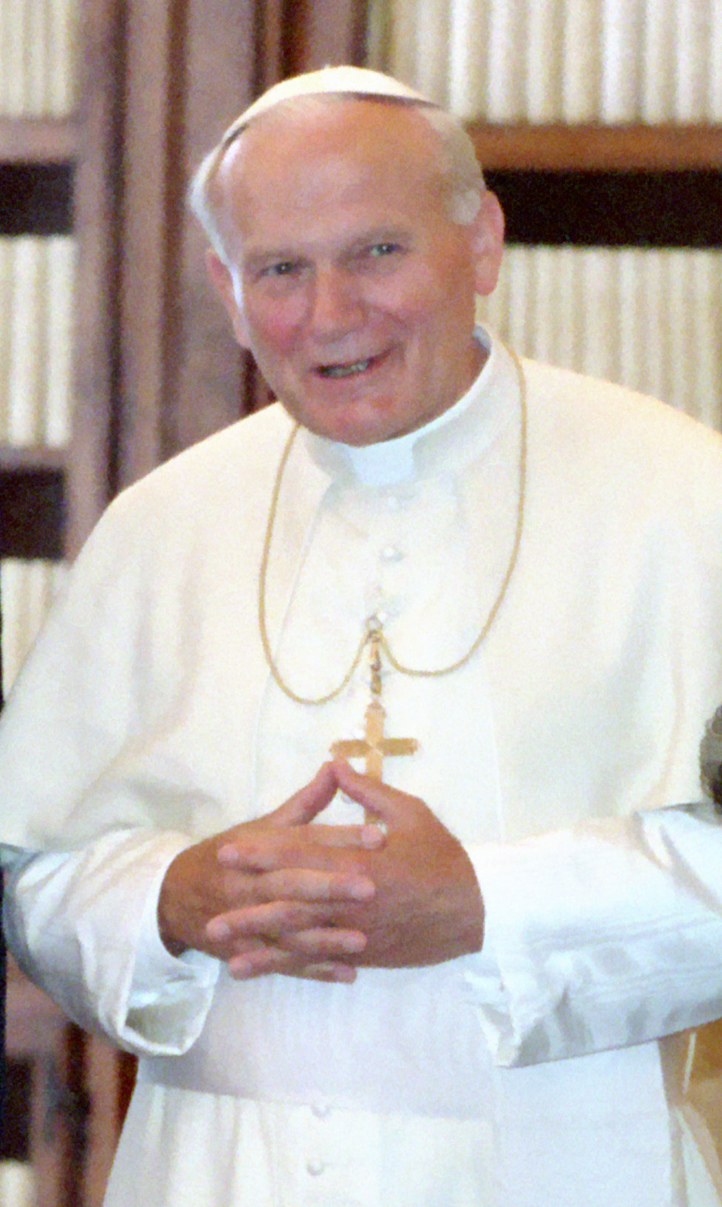
On October 22, 1978, a man stood in St. Peter’s Square six days after being elected pope and told the crowd, and the world, not to be afraid. The Church now remembers Saint John Paul II on that date every year. Before he was the pope who travelled the globe, he was a student actor, a quarry worker and a seminarian in hiding.
This article sticks to the Vatican’s own record. The biography comes from the Holy See’s biographical documents, the quotations from the homily at the start of his pontificate, and the canonization from the homily of Pope Francis.
Wadowice, 1920
Karol Józef Wojtyła was born on May 18, 1920, in Wadowice, Poland, and baptized on June 20. His mother, Emilia, died on April 13, 1929, when he was nine. His brother Edmund, a physician, died on December 5, 1932. His father, also called Karol, died on February 18, 1941. By his early twenties he had lost his whole immediate family.
Theatre, Then a Quarry
In June 1938 he enrolled at the Jagiellonian University in Kraków to study philosophy, and he took part in student theatre. After the German occupation closed the university, he worked from November 1, 1940, as a stone cutter in the Zakrzówek quarry, which kept him employed and out of deportation. In the spring of 1942 he moved to the Solvay chemical plant, where he worked until August 1944. He kept acting in underground theatre until March 1943.
A Seminary in Hiding
In October 1942 he began studying theology in Kraków’s clandestine seminary. In August 1944, Archbishop Adam Stefan Sapieha moved him to the Archbishop’s Residence, where he stayed until the end of the war. He was ordained a priest on November 1, 1946, and celebrated his first Mass the next day in the crypt of Saint Leonard at Wawel. His doctoral thesis, defended in 1948, was on Saint John of the Cross.
Bishop, Archbishop, Cardinal
He became auxiliary bishop of Kraków on July 4, 1958, and was ordained a bishop on September 28, 1958. He was installed as archbishop of Kraków on March 8, 1964, and made a cardinal by Paul VI in 1967.
October 16 and 22, 1978
The conclave began on October 14, 1978. On October 16, at about 5:15 p.m., Cardinal Wojtyła was elected as the 264th pope. Six days later, on Sunday, October 22, in St. Peter’s Square, he began his pontificate with a homily built on one repeated phrase. The Vatican’s English text renders it:
- “Do not be afraid to welcome Christ and accept his power.”
- “Do not be afraid. Open wide the doors for Christ.”
- “Do not be afraid. Christ knows ‘what is in man’.”
In the same homily he said that he was not Roman by birth but became a Roman by taking up the office, and he asked the faithful to pray for him as he took on the service. He also set aside the papal tiara, which he called a symbol of temporal power, and described the authority of the pope as service.
The Attack and the Journeys
On May 13, 1981, at 5:19 p.m., Mehmet Ali Agca shot the pope in St. Peter’s Square. John Paul II survived. His pontificate was marked by long journeys; the Vatican’s own list has already reached Apostolic Voyage number 78 by his visit to Poland in 1997. It also records the first meeting of young people he called a World Youth Day, in Rome on March 30 and 31, 1985.
Death, Beatification, Canonization
John Paul II died in the Vatican on April 2, 2005, at 9:37 p.m. His funeral was celebrated on April 8 in St. Peter’s Square, and he was buried in the Vatican Grottoes. He was beatified on May 1, 2011, with Benedict XVI presiding, and Pope Francis canonized him, together with John XXIII, on April 27, 2014, Divine Mercy Sunday.
In his homily, Pope Francis said the two new saints “were not afraid to look upon the wounds of Jesus.” He called John Paul II the pope of the family. In 2014 the Church placed his memorial in the General Roman Calendar on October 22, as an optional memorial. The decrees do not state why that date was chosen, but it is the date of the Mass that began his pontificate.
One thing to do this week
Choose one thing you are afraid to do, a conversation, a confession, a phone call to someone you have avoided, and do it once this week. Not as a speech, but as the plain step John Paul II named in 1978: open one door for Christ.
If stories like this one stay with you, there are fifty more in 50 Saints: Stories and Prayers for Divine Intervention — fifty lives from across the history of the Church, each paired with a prayer. Find it in the Catholic Journey shop.
Sources
- Tier 1: John Paul II, Homily at the Mass for the beginning of his pontificate, October 22, 1978 (vatican.va).
- Tier 1: Holy See Press Office, Biography of John Paul II before the pontificate, and during the pontificate.
- Tier 1: Pope Francis, Homily at the canonization of John XXIII and John Paul II, April 27, 2014 (vatican.va).
- Tier 1: Congregation for Divine Worship, Decree inserting John XXIII and John Paul II in the General Roman Calendar, 2014 (vatican.va).
- Tier 1: U.S. Conference of Catholic Bishops, Daily readings for October 22, 2026.
Image credits
- Pope John Paul II, June 6, 1987. White House Photographic Collection (Reagan Library). Public domain, via Wikimedia Commons.