
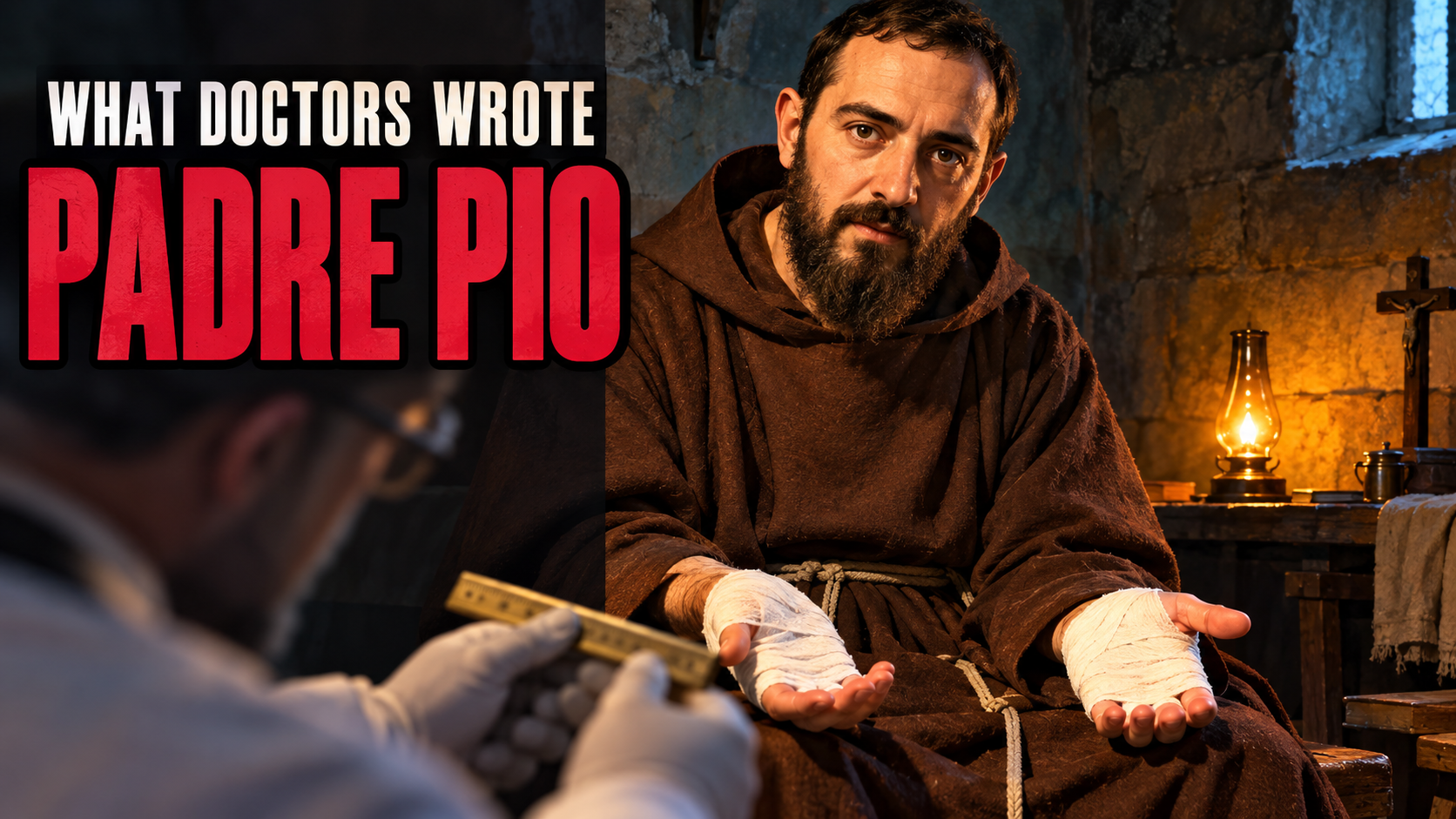
Between 1919 and 1920, three doctors examined the stigmata of Padre Pio: the wounds in his hands, his feet and his side. They did not agree. Two wrote that science could not explain them. The third called them self-produced by suggestion, and said they were kept up with iodine.
By his death in 1968, the wounds were gone. Forty years later, his coffin was opened. The record never stops arguing with itself. This is that record, laid out document by document: what each doctor wrote, what the Church’s own investigator concluded, what Rome restricted and what it did not, and what the canonization actually judged.
Underneath it sits a plainer question. If a saint’s wounds can be argued over for a century, what exactly is a Catholic asked to believe?
A note on sources before we begin. The findings of the doctors below are quoted as recorded in published biographies. The primary texts of those reports were not available for this article, and where the sources disagree, the article says so instead of choosing a side.
Watch the video: on YouTube or on Rumble.

What Rome Actually Said
Start with the Church’s own record. On June 16, 2002, Pope John Paul II proclaimed Padre Pio a saint in St. Peter’s Square. Three years earlier, on May 2, 1999, the same Pope had beatified him, and in that homily he spoke of a body marked by the stigmata, marked, he said, to show the intimate bond between death and resurrection. At the canonization he spoke of the glory of the Cross shining in him.
Read both homilies closely. Neither one cites a medical report, an X-ray, or a doctor’s name. They speak of the Cross. Canonization judges a life of heroic virtue. No Vatican text gathered for this article rules on where the wounds came from. That question stayed with the doctors.

What Did the First Doctors Actually See?
The Vatican’s own account places the beginning on September 20, 1918, in the choir of the small convent church. A few weeks earlier, from August 5 to 7, came what that account calls his transverberation. The wounds followed.
Dr. Romanelli of the Barletta hospital first examined Padre Pio in May 1919 and kept coming back: five examinations in all, the last in July 1920. As the biographies record it, he measured the hand wounds at about an inch and a half on the right and about one inch on the left, covered by a red-brown elastic membrane and without inflammation. The side wound he described as about 7 centimeters long, a straight line. Remember that detail. In the record, it will not stay straight.
Romanelli’s written conclusion, as the biographies record it: the cause of these lesions was not natural, and had to be sought in the supernatural.
In July 1919 a second doctor came from Rome, Professor Amerigo Bignami, described in the sources as a skeptic. He ordered a test. The wounds were bandaged and sealed for eight days, under a committee that included three friars. On the eighth day the bandages came off, and Bignami’s report says the wounds remained the same. Then came his explanation: the lesions were “unconsciously self-produced by autosuggestion, and kept artificially with repeated applications of tincture of iodine.”
Sealed for eight days, unchanged, and his hypothesis still named iodine. How he squared those two, the sources used here do not say.
Who Actually Looked? Festa Against Gemelli
A third doctor, Giorgio Festa, examined the wounds on October 9 and 10, 1919, and dated his report October 28. On the wounds and their bleeding, the biographies quote him directly: “an origin that our knowledge is very far from explaining,” and, he added, well above human science. That makes two doctors writing past the edge of medicine, and Bignami alone on the other side.
Then, in April 1920, came Father Agostino Gemelli, a Franciscan, a physician and a psychologist, the name this case still argues over. The visit was short. One account dates it April 18, another April 19. One says the conversation lasted three or four minutes. By those accounts he never saw the wounds, and his report diagnosed suggestion. In 1925 Festa answered with a refutation 72 pages long. Its charge was simple: Gemelli did not examine the wounds.
Then the story shifted. A 1926 report by Gemelli claims earlier visits, in 1919, and an examination. Here the historians disagree. One reading of the archives says he did see the stigmata, undercover, in 1919. Other witness accounts conflict. In August 1933 Gemelli wrote that his 1924 remarks about stigmata that science could explain were about others, not Padre Pio.
The popular telling gets Gemelli wrong both ways: the villain who never looked, or the scientist who saw straight through it. The record supports neither cleanly. It shows a short visit, a firm diagnosis, and a quarrel over what he saw that is still open.
What Did Rome Conclude, and Why Did It Restrict Him Anyway?
Meanwhile, in July 1920, two sworn statements had reached the Bishop of Foggia. A pharmacist, Domenico Valentini Vista, and his cousin, Maria De Vito, swore that Padre Pio had made the wounds himself, with phenolic acid and veratrine. The sources record this as an allegation, and that is how it stays here. It would return 87 years later.
On June 14, 1921, the Holy Office’s investigator arrived: Bishop Carlo Raffaello Rossi. He stayed about eight days and questioned Padre Pio himself. According to CNA/EWTN News, which reported on the file in 2008, the report preserves one line of Padre Pio’s answer: “I heard this voice: ‘I unite you to my Passion.'” Rossi also looked at the wounds. He wrote of a radiant aspect, and the side wound, in his report, was triangular.
Two years earlier, Romanelli had written a straight line. Same wound, two shapes. Nothing in the sources used here explains the difference.
Rossi’s verdict: the wounds were authentic, not the work of the devil, not fraud, and the man himself a good and exemplary religious. That report went into the Holy Office archive and surfaced in the press only in September 2008, after the archives were opened.

And yet Rome moved the other way. Restrictions on public access began in 1922. In 1923 the Holy Office declared non constare: the supernatural origin was not established. Statements denying it followed, into 1931. In 1931 he was barred from all but a private Mass, with no public celebration and no confessions. The sources do not even agree on the month: March, May or June. The years are what is certain.
In 1933 Pope Pius XI reversed the ban, and in 1934 his priestly faculties came back, step by step. Twelve years of restrictions, from 1922 to 1934. Anyone who has lived under a verdict they did not choose knows that weight.
What Did the X-Ray Show, and Where Did the Wounds Go?
The wounds stayed open through all of it. Then, in October 1954, a doctor looked beneath the skin. Dr. Alberto Caserta of Foggia X-rayed the hands and feet and, as the biographies record it, found absolutely nothing abnormal in the bones. The wounds, though, were plainly visible.
In testimony from 1968, a Dr. Cardone described the hand wounds as holes, a bit over half an inch across, passing through, and said that light could be perceived through them. That is a witness’s testimony, not an examination report. An X-ray that found nothing in the bone, and a witness who described light through the hands: the record does not reconcile them.
In 1960 there was one more inquiry, an Apostolic visitation after slanderous remarks, and Pope Paul VI lifted the resulting restrictions soon after his election. Padre Pio died during the night of September 23, 1968, aged 81, fifty years and three days after the choir.
The Vatican City State’s feast-day page says: “The stigmata on his body had disappeared without leaving any trace.” Before his death, says the Vatican’s account. At the moment of death, an archbishop would later say. Forty years on, they opened the tomb.

What Happened When the Accusation and the Coffin Were Reopened?
First, the accusation came back. In 2007, historian Sergio Luzzatto published a book drawn from Vatican archives. His claim: Padre Pio secretly ordered carbolic acid, which he might have used to create the wounds. Eighty-seven years after the pharmacist’s sworn statement, a chemical was again being named as the source of the wounds.
Did Rome answer him? No official Vatican reply turned up in the sources behind this article. And the acid stays what it was: alleged. This article does not say whether acid was or was not used, and it does not equate the 1920 “phenolic acid” with Luzzatto’s “carbolic acid”, since the Italian original of the earlier statement was not checked.
Then, at half past midnight on Monday, March 3, 2008, the tomb at San Giovanni Rotondo was opened. Medical experts did the work, and Church representatives watched. He had lain there since his burial on September 27, 1968. Archbishop Domenico D’Ambrosio spoke for the Church, and CNA/EWTN News reported his words: “The body is well preserved.”
Well preserved. That is the phrase on record. The word “incorrupt” appears nowhere in these sources, so it is not borrowed here. As for the hands and feet, there was no trace of the stigmata. As we know, the archbishop added, they disappeared at the moment of his death.

That April, after a Mass at San Giovanni Rotondo, public veneration began. Some 750,000 people had already signed up to come.
So What Does the Record Prove, and What Did the Church Judge?
Lay the file out. Two doctors who wrote beyond science. Two diagnoses of suggestion. One bishop: authentic. One Holy Office decree: not established. One X-ray: nothing abnormal. One witness: holes with light through them. One coffin: no trace of the wounds. The file does not close.
So what is a Catholic asked to believe? Rome canonized a man for heroic virtue, and its homilies cite no doctor. At the canonization, John Paul II said what that life showed: “The life and mission of Padre Pio prove that difficulties and sorrows, if accepted out of love, are transformed into a privileged way of holiness, which opens onto the horizons of a greater good, known only to the Lord.”
The wounds were never the verdict. Fifty years of carrying them was the witness. That is a reading, and Rome does not rule on it.
One thing to do this week
For the next seven mornings, name one sorrow you cannot explain or fix. Offer it, out of love, for one person, by name. Then leave a first name in the comments, and others will pray too.
An inch and a half in a doctor’s notebook. A privileged way of holiness in a Pope’s homily. The record holds both.
If stories like this one stay with you, there are fifty more in 50 Saints: Stories and Prayers for Divine Intervention — fifty lives from across the history of the Church, each paired with a prayer. Find it in the Catholic Journey shop.
Sources
- Tier 1: Saint John Paul II, homily for the canonization of Padre Pio, June 16, 2002, and homily for the beatification, May 2, 1999 (vatican.va).
- Tier 1: Vatican City State, “23 September: Saint Pio of Pietrelcina”, and Vatican News, “St. Pius of Pietrelcina, priest”: the stigmata of 1918, the 1931-1933 restrictions, the 1960 visitation, the death in 1968 and the disappearance of the wounds.
- Tier 3: CNA / EWTN News, “Details of first investigation into Padre Pio’s stigmata revealed” (Rossi inquiry, 1921), “Padre Pio exhumed body is well preserved” (March 2008) and the report on public veneration (April 2008); EWTN, “Highlights of Padre Pio’s Life”: the chronology of the restrictions.
- Tier 3: Avvenire, “Padre Pio, storia da rifare?”: the 1920 sworn statements, the 1923 non constare and the 1933 letter of Gemelli; Sowetan, October 29, 2007: the Luzzatto claim.
- Tier 3: a devotional-site compilation of the medical examinations that cites printed biographies: the findings of Romanelli, Bignami, Festa and Caserta and the Cardone testimony. The primary reports were not available for this article, so these findings are reported as recorded in the biographies and should be read with caution.
Image credits
- Padre Pio, detail from a photograph taken on August 19, 1919, Placido Bux. Public domain, via Wikimedia Commons.
- Sicht vom Petersdom, Rom, Lukask, 2004. CC BY-SA 3.0, via Wikimedia Commons.
- Padre Pio durante una messa, undated photograph, transferred from Italian Wikipedia. Public domain, via Wikimedia Commons.
- Padre Pio, 1947, presumably by Federico Abresch (d. 1969). Public domain, via Wikimedia Commons.
- Il vecchio convento di Padre Pio, San Giovanni Rotondo, scan of a 1953 postcard by Stefano Ciavarella. Public domain, via Wikimedia Commons.