
Everyone knows the number. Nine hundred and sixty-nine years, the longest life recorded anywhere in Scripture. What almost nobody points out is where that life ends.
Genesis never says it out loud. You have to do the arithmetic yourself, and the text leaves all three numbers lying on the page:
- Methuselah is 187 when his son Lamech is born (Genesis 5:25).
- Lamech is 182 when Noah is born (Genesis 5:28).
- Noah is 600 when the water comes (Genesis 7:6).
187 + 182 + 600 = 969. Exactly the span Genesis 5:27 gives him, to the year.
The longest life in the Bible runs out in the very year of the judgement. Not before it. The year of it.
The curve, not the record
Read Genesis 5 as a list of record-holders and it is merely strange. Read it as a curve and it starts arguing.
Before the Flood the numbers are enormous and steady — Adam 930, Seth 912, Noah 950. Afterwards they fall, and keep falling: Shem 600, Arphaxad 438. By Abraham it is 175. By Moses, 120. By the time somebody writes Psalm 90, a human life is seventy years, eighty if you are strong. That is still where we are.
Genesis 5 is also not the only ancient list of impossibly long-lived ancestors. The Sumerians kept one, pressed into wet clay with a cut reed, and their antediluvian kings do not reign for hundreds of years — they reign for tens of thousands. Against that, Genesis is restrained. The study notes in the American bishops’ own Bible make exactly this comparison: the same literary genre, the same position in the story, with the numbers pulled down and pointed somewhere else.
The Bible where the sum breaks
Everything above depends on which Bible you are holding, and that is not a technicality.
The Hebrew text, the Greek Septuagint and the Samaritan Pentateuch tell the same story in Genesis 5 with three different sets of numbers. Adam to the Flood comes to 1,656 years in Hebrew, 1,307 in the Samaritan text, and 2,242 in Greek — the Septuagint having added a hundred years to six of the patriarchs, each time at the birth of his heir.
St Jerome, working from Hebrew in Bethlehem for some fifteen years, went back to the Hebrew and stayed with it. That is why the Latin Vulgate — and every Catholic Bible descended from it — carries the numbers that make the sum work.
Because in Greek, it does not work. Run the same arithmetic there and Methuselah outlives the Flood by fourteen years. He is not on the ark; Genesis says eight people came through the water, and he is not one of the eight.
Augustine spent three chapters on it
The problem is old, and the man who took it apart is the most quoted theologian in the history of the Church. The City of God, Book XV.
He starts by closing the easy exit. Someone had proposed that the ancient years were shorter — that a “year” then meant a month, ten of theirs to one of ours, so that 969 becomes about 97. Tidy. Augustine will not have it:
“For they are by no means to be listened to who suppose that in those times years were differently reckoned, and were so short that one of our years may be supposed to be equal to ten of theirs.”
— The City of God, Book XV, chapter 12
His argument is arithmetic rather than authority: run the month theory through the genealogy and one of the patriarchs fathers a child at the age of seven.
Then, in chapter 11, he takes the Methuselah discrepancy head on. He does not defend the Greek numbers and he does not accuse anyone of forging them. He blames a copyist — one error, made early, in the first copy taken from the library at Alexandria, and multiplied by every copy after it. In the fifth century, with no critical editions and no catalogue of manuscripts, he reasons his way to a scribal error from the shape of the discrepancy alone.
And in chapter 14 he does the thing nobody expects: he argues those were real solar years, and his evidence is the Flood itself. Genesis does not date it loosely — it dates it to the six hundredth year of Noah, the second month, the twenty-seventh day. A text using vague poetic years does not stop to name the day.
Two things the popular version gets wrong
The name. You will be told that “Methuselah” means when he dies, it shall be sent — the Flood encoded in a baby’s name. It is a beautiful reading. It is also not the agreed meaning of the word. The Catholic Encyclopedia lists the serious candidates and that one is not among the favourites; “man of the javelin” is one, “man of Selah” another. The honest answer is that the sources do not agree, and that is the answer almost nobody gives.
The Nephilim. Nearly every video on this subject explains the long lifespans with Genesis 6 — fallen angels, human women, a corrupted bloodline. No Vatican document teaches this. There is no Catholic doctrine on the identity of the “sons of God” in Genesis 6 at all, and the angelic reading runs into something the Church does teach: angels are pure spirits, and pure spirits do not father children. It is why many Catholic exegetes read the passage as the line of Seth instead.
What the Church actually requires
Less than the internet assumes, and more than it admits.
In Divino Afflante Spiritu (1943), Pius XII instructed interpreters to work out how people actually wrote in those far-off times, allowing for “certain fixed ways of expounding and narrating, certain definite idioms… so-called approximations, and certain hyperbolical modes of expression.” That is a Pope, in 1943, saying that ancient numbers may not be doing what modern numbers do.
Five years later the Pontifical Biblical Commission wrote to the Archbishop of Paris about the first eleven chapters of Genesis specifically, finding that they belong to no literary category we own, so their historicity can be neither simply denied nor simply affirmed. Pius XII endorsed that letter in Humani Generis (1950) — paragraph 38, footnote 13:
“…the first eleven chapters of Genesis… do nevertheless pertain to history in a true sense, which however must be further studied and determined by exegetes.”
— Humani Generis, 38
And here is the part worth slowing down for. In the same sentence that endorses the letter, Pius XII warns that people were already misusing it — that they “wrongly refer” to it — in order to throw doctrine out. The door to literary form opens and the door to doctrine locks in one paragraph.
The Second Vatican Council put the same principle into Dei Verbum 12, and article 11 draws the boundary of what Scripture guarantees: “that truth which God wanted put into the sacred writings for the sake of our salvation.” A chronology is not what that sentence is protecting. The Catholic Encyclopedia said the quiet part a century ago — for this period, “the freedom of the Catholic in investigating the chronology… is quite unrestricted.”
So the line is clear enough to state plainly:
- Binding: a real common origin of the human race in our first parents, and a real primeval Fall — Humani Generis 37 and Catechism 390, which affirms that Genesis 3 “uses figurative language, but affirms a primeval event.”
- Free: whether the Genesis 5 numbers are literal chronology or an ancient literary form. You may read 969 as counted years with Augustine, or as a literary device with the exegetes Rome sent to work. Neither is heresy.
What the time was for
Whichever reading you hold, the number does the same thing.
If those are counted years, then the longest life God ever granted a man ran out in the exact year of the judgement. If they are a literary form, then the author wrote that ending on purpose — which is a stronger claim about the number, not a weaker one.
Either way, 969 is not a measure of how long a man can live. It is a measure of how long God waited. Peter reads the Flood exactly this way: the people of that age were those “when they waited for the patience of God in the days of Noe” (1 Peter 3:20), and a chapter later he says it again — God is not slow, but patient, unwilling that any should perish.
Every popular version of this story tries to explain the number away. Biology, fallen angels, a shorter year. All of them treat 969 as a problem to be solved. Read it as a clock and it stops being a problem and becomes a warning. That is a reading, and the Church does not rule on it.
Watch the full video
The whole argument, with the arithmetic on screen: Catholic Journey on YouTube.
Go deeper
If stories like this one stay with you, there are fifty more in 50 Saints: Stories and Prayers for Divine Intervention — fifty lives from across the history of the Church, each paired with a prayer. Find it in the Catholic Journey shop.
Sources
Tier 1 — Magisterial.
Pius XII, Divino Afflante Spiritu (1943), 35–39.
Pius XII, Humani Generis (1950), 37 and 38 with footnote 13 — where the Pontifical Biblical Commission’s 1948 letter to Cardinal Suhard is endorsed by name.
Second Vatican Council, Dei Verbum, 11 and 12.
Catechism of the Catholic Church, 289 and 390.
Tier 2 — Patristic and scholarly.
St Augustine, The City of God, Book XV, chapters 11, 12 and 14.
Catholic Encyclopedia, “Methuselah” and “Biblical Chronology”.
USCCB study notes on Genesis 5.
Tier 3 — Scripture text and background.
Genesis 5:25, 5:27, 5:28 and 7:6; 1 Peter 3:20; 2 Peter 3:9 (Douay-Rheims). Sumerian King List reign-lengths from standard reference sources.
Image credits
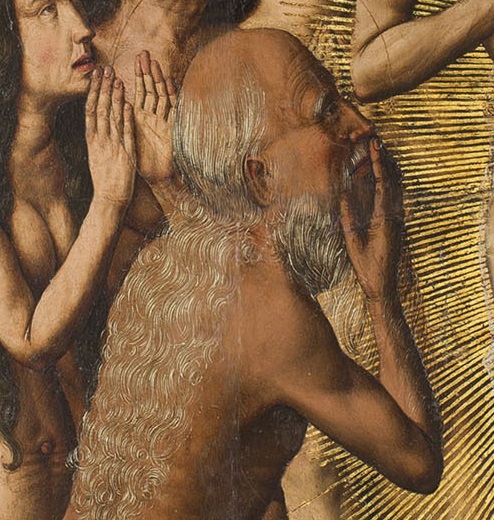
Methuselah by Bartolomé Bermejo, fifteenth century — public domain, via Wikimedia Commons.
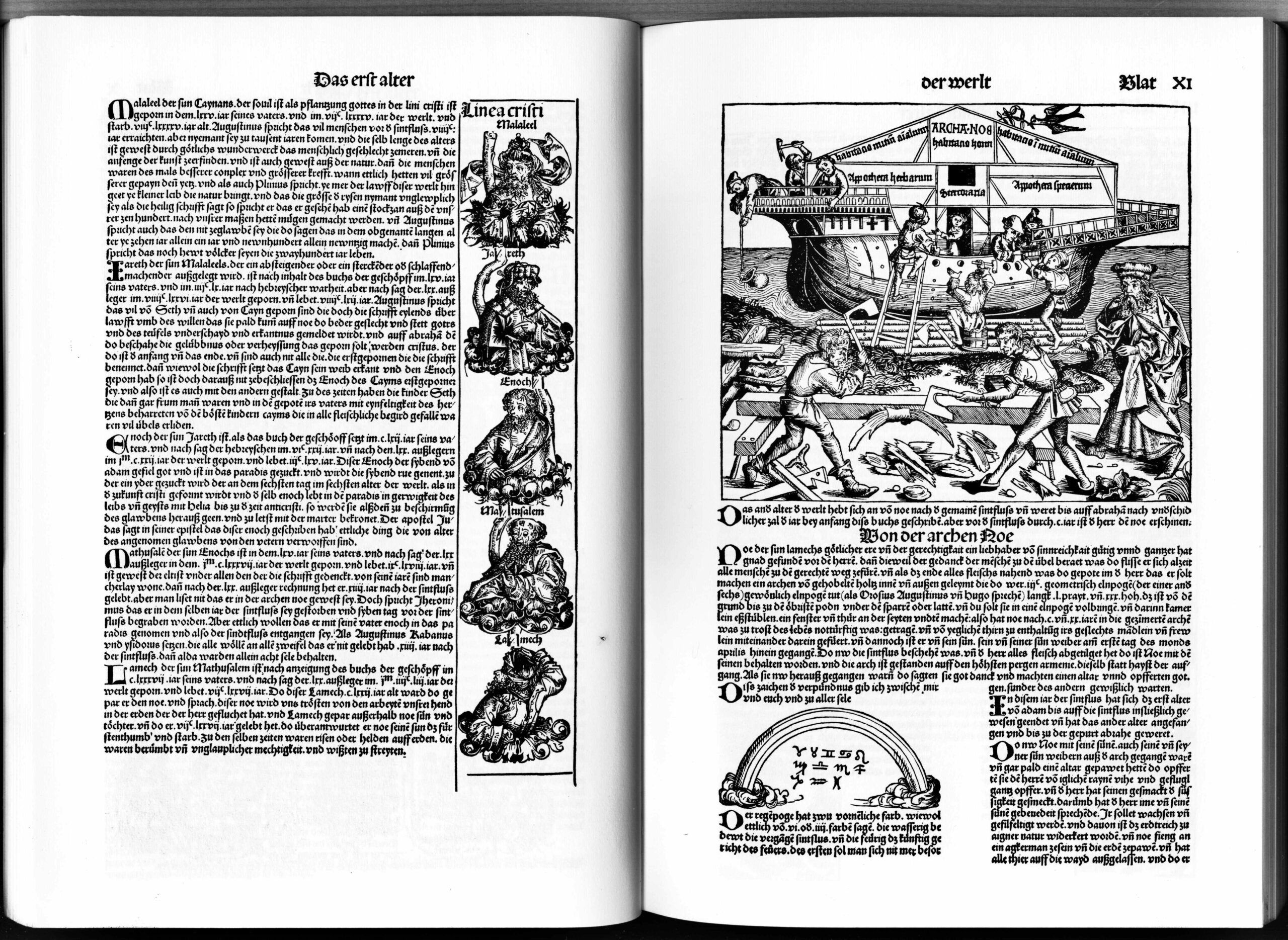
Antediluvian genealogy woodcut from Hartmann Schedel’s Nuremberg Chronicle, 1493 — public domain, via Wikimedia Commons.
Remaining illustrations original to Catholic Journey.