
Edmund was a teenage king of East Anglia who is remembered for how he died. What we can say about his death rests on sources written long after it, and that is the first thing to know about him.
The king
The Catholic Encyclopedia says Edmund was born about 840 and crowned in 855, “about fifteen years old.” It adds that he spent a year in a royal tower at Hunstanton learning the Psalter by heart. Later legends give him a foreign birthplace; the earliest accounts make him a descendant of the East Anglian kings.
The Danes
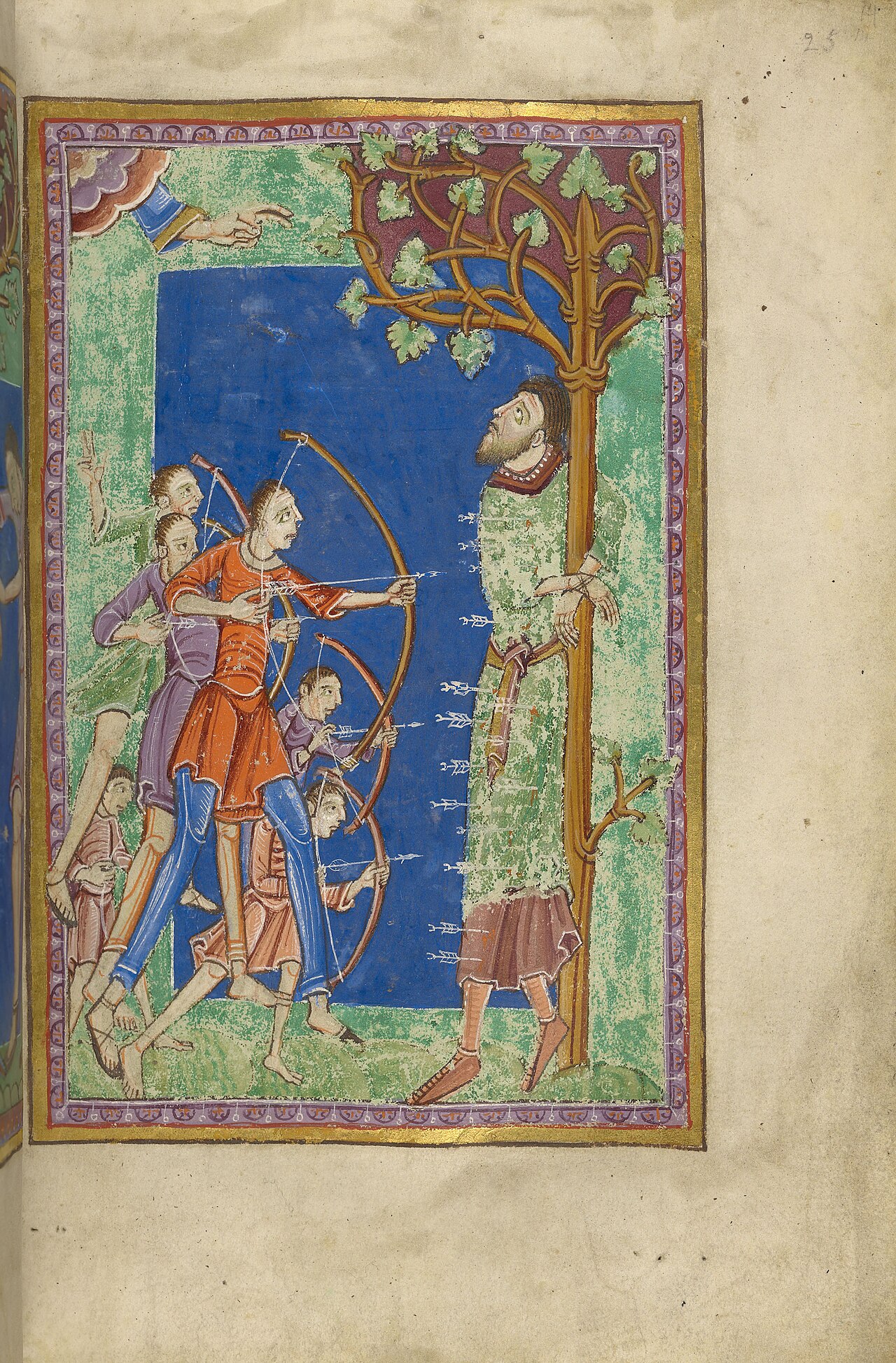
In 870 the Danish chiefs Hinguar and Hubba returned to East Anglia with overwhelming numbers. According to the Catholic Encyclopedia, Edmund disbanded his troops to avoid a massacre, was captured near Framlingham and refused the Danes’ demands, saying his religion was “dearer to him than his life.” They beat him, tied him to a tree, whipped him and shot arrows until his body “had the appearance of a porcupine.” Hinguar then ordered his head cut off. The place was Hoxne in Suffolk, and the day was November 20.
What we can and cannot check
- Late sources. The Catholic Encyclopedia relies on Abbo of Fleury’s Passio of 985, more than a century after the death, and on a later writer, Gaufridus de Fontibus (about 1150). We did not read Abbo’s text itself.
- The year. The Catholic Encyclopedia gives 870; other sources give 869. The sources we read do not settle it.
- Legends. We found no support in the sources we read for the story of the wolf that guarded his head, so we leave it out.
The Catholic Encyclopedia says he was first buried at Hoxne, and that in the tenth century his relics were moved to Beodricsworth, “since called St. Edmundsbury,” where the abbey of that name arose. His feast is November 20.
One thing to do this week
Edmund refused to trade his faith for his life. Name one small thing you are tempted to trade away to avoid friction, and do not trade it this week.
If stories like this one stay with you, there are fifty more in 50 Saints: Stories and Prayers for Divine Intervention — fifty lives from across the history of the Church, each paired with a prayer. Get the ebook. You can also browse everything else in the Catholic Journey shop.
Sources
- Catholic Encyclopedia, “St. Edmund, King of East Anglia”.
Image credits
- The execution of Edmund, folio 14r of Pierpont Morgan Library MS M.736, 12th century. Public domain, via Wikimedia Commons. A medieval illustration, not a portrait.