
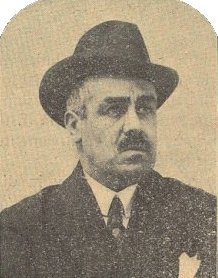
On October 15, 1917, Lisbon’s largest newspaper — one openly hostile to the Catholic Church — put the word miracle on its own front page. Its editor had gone to the field three days earlier for the opposite reason: to expose a promised miracle as a clerical hoax, once and for all. His name was Avelino de Almeida, editor of O Século, proudly republican and openly anticlerical.
Before the drama, here is the Church’s actual position, stated plainly. In 2000, the Vatican’s doctrine office published the complete record of Fátima, including the long-sealed “third secret.” That same year, Pope John Paul II beatified two of the three children who reported the apparitions, at the field itself. In 2017, Pope Francis canonized both Francisco and Jacinta Marto — among the youngest non-martyrs ever declared saints. Four popes have knelt at that field in person: Paul VI, John Paul II, Benedict XVI, and Francis.
None of that explains what tens of thousands of people — including a hostile press — said they saw on October 13, 1917. To understand that, you have to go back three years earlier.
Who were the children
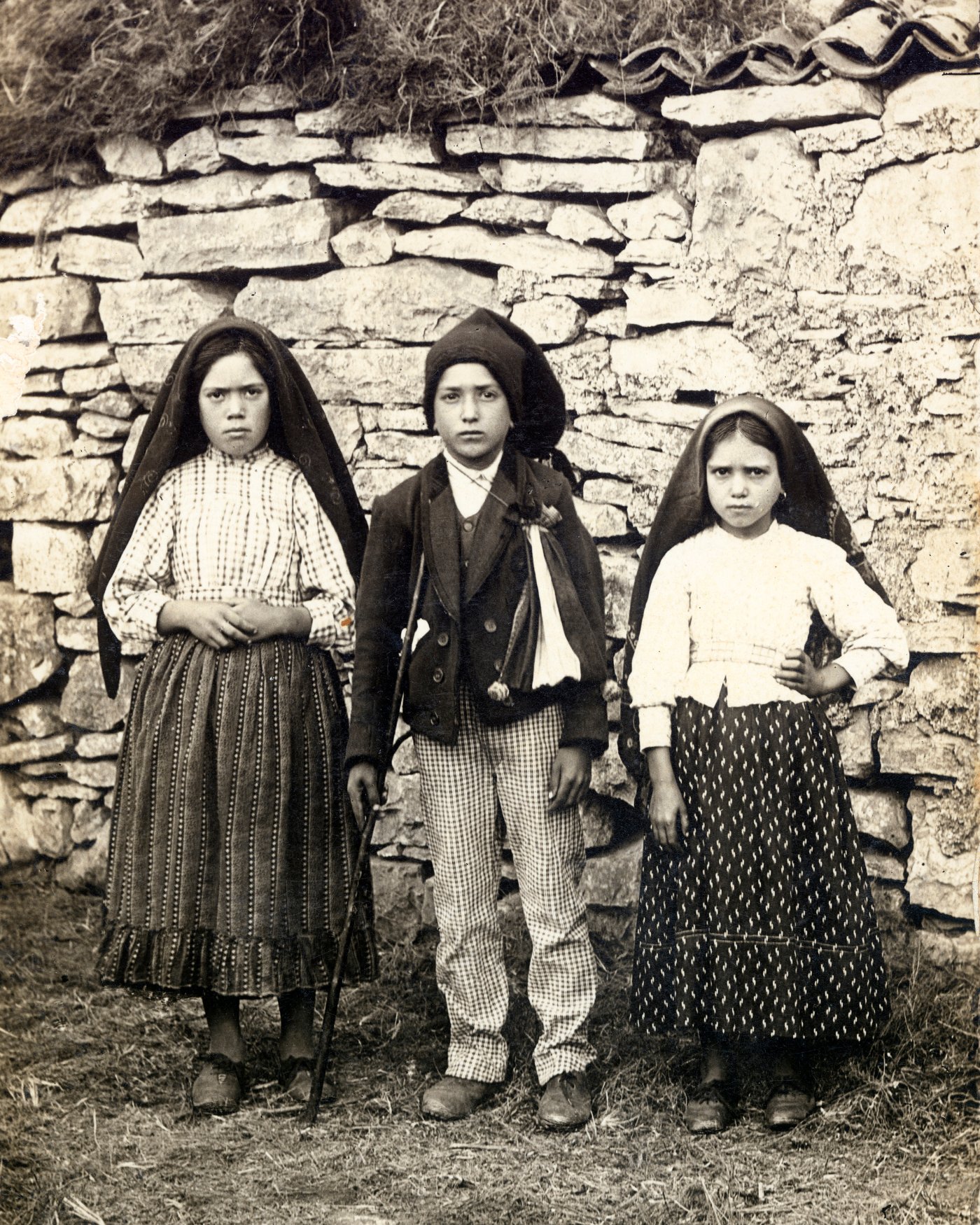
Fátima sat inside a Portugal governed by a fiercely anticlerical republic that had expelled religious orders and restricted public religious processions. Three shepherd children herded sheep there: Lúcia dos Santos, age 10, and her younger cousins Francisco and Jacinta Marto, ages 9 and 7.
A year earlier, in 1916, all three said an angel appeared to them three times and taught them a prayer of reparation. On May 13, 1917, they said a woman “brighter than the sun” stood above a small holm oak and spoke with them. By July, according to the children, she had promised a sign so that people would believe: return in October, and a miracle would be worked.
In August, a local administrator detained all three children and, by their account, threatened them to force a confession that it was invented. None of them changed their story. By September the crowds following them numbered in the tens of thousands, and some witnesses reported unusual lights in the sky. Word had spread across Portugal: on October 13, at that exact field, a sign had been promised.
What witnesses described at the Cova da Iria
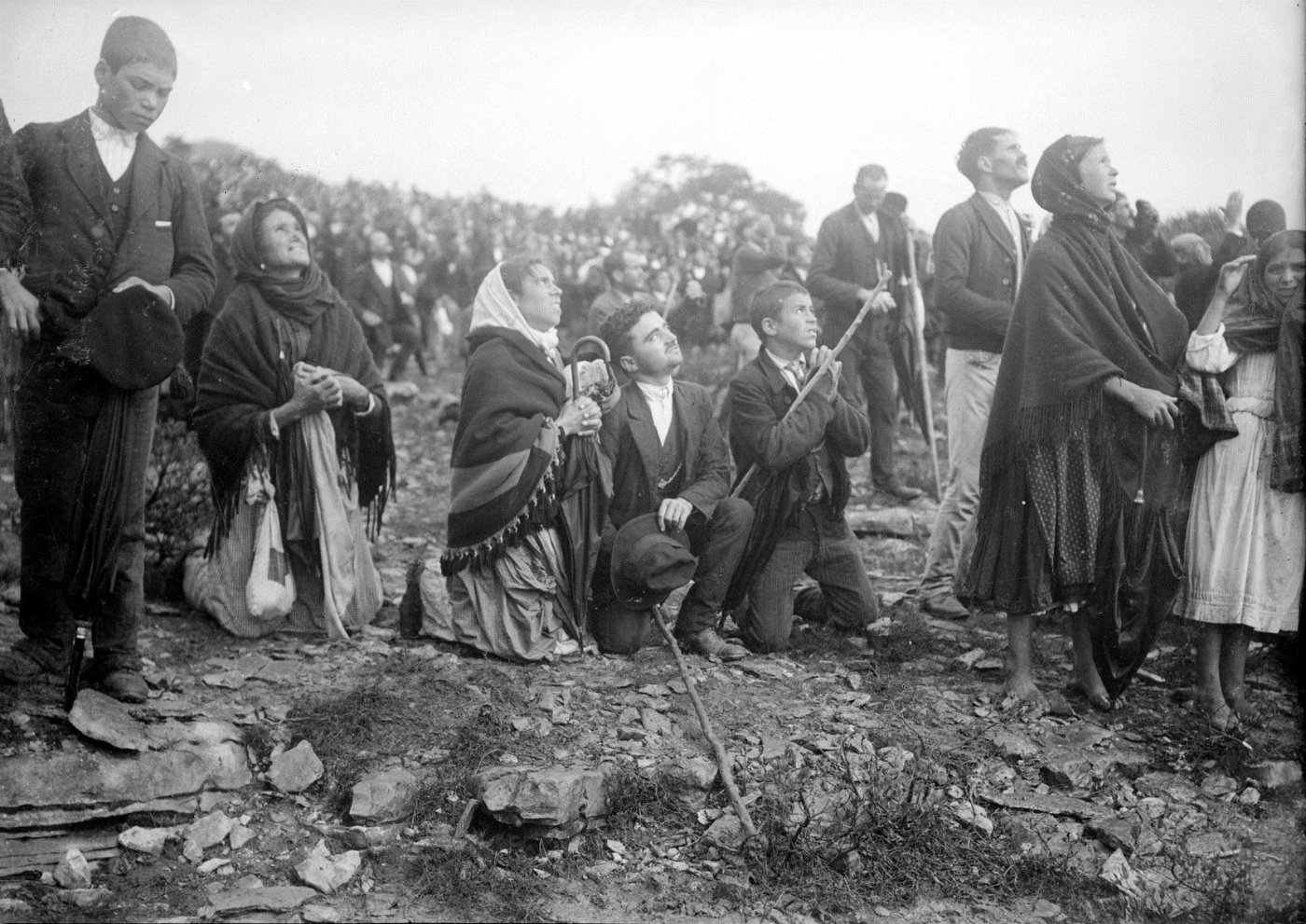
Historians generally estimate around 70,000 people in the field that day, with accounts ranging from 30,000 to more than 100,000. It had rained for hours — cold, heavy rain that soaked the crowd and turned the ground to mud.
Around 1:30 in the afternoon, the children said their conversation with the “Lady” ended. She had given a title — Our Lady of the Rosary — asked for a chapel on the spot, said the war would end soon, and asked people to stop offending God. Then Lúcia pointed upward and called out to the crowd to look at the sun.
According to a large body of witness accounts, the rain clouds parted and the sun appeared as a dull silver disk that people said they could look at directly without pain. Many described it as spinning on itself, throwing off bands of colored light — red, yellow, violet, green, blue — that fell across the crowd and the landscape. In the final moments, many witnesses said the disk seemed to break loose and plunge toward the earth in a zig-zag before returning to its place. A number of people reported that their rain-soaked clothes and the muddy ground had dried. Witness estimates of the total duration cluster around 10 minutes.
What the reporters sent to mock it actually wrote
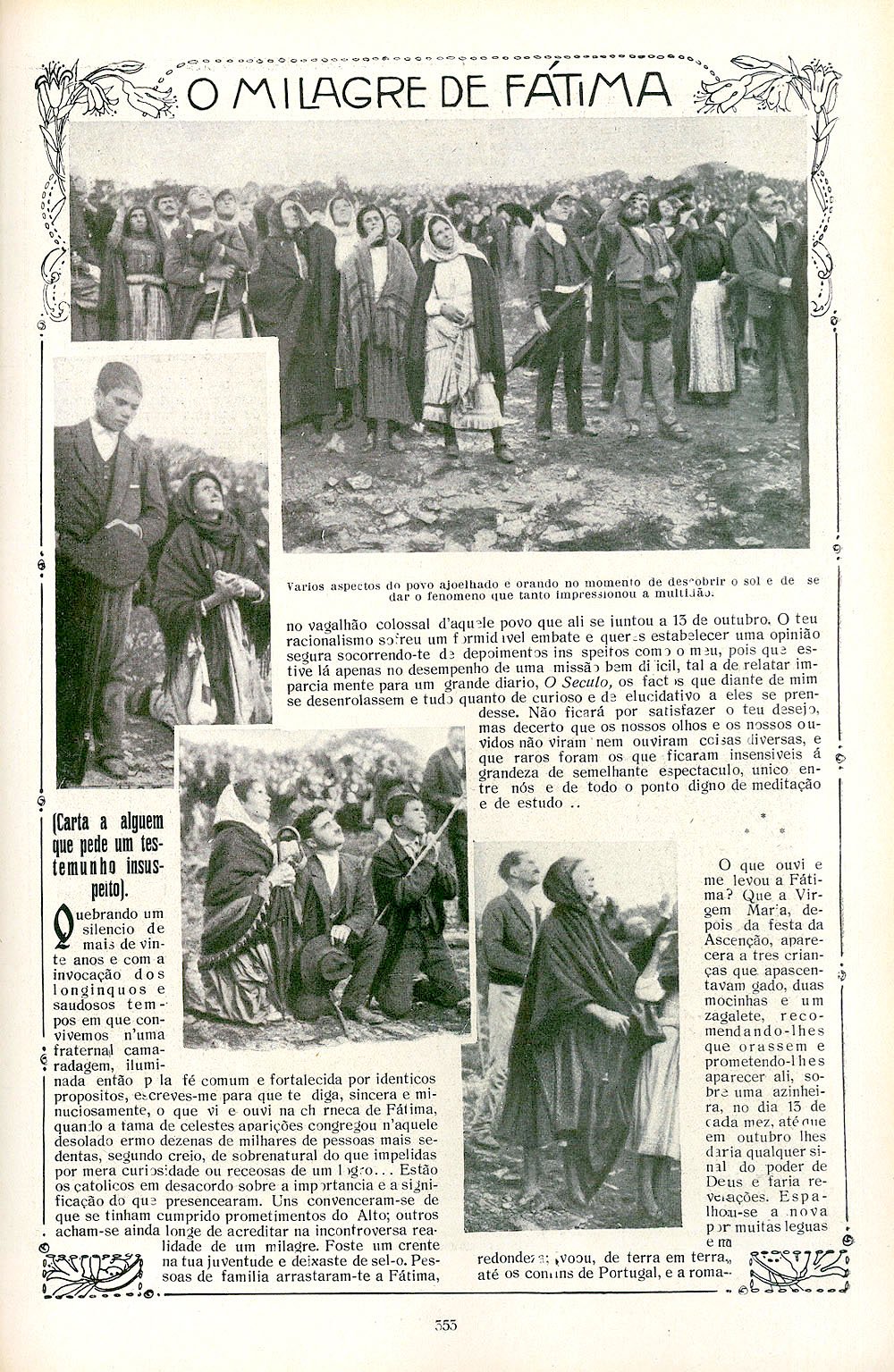
Avelino de Almeida’s account ran in O Século on October 15, 1917. He described “a plate of dull silver” that could be looked at without effort and that “does not burn, it does not blind,” and reported the crowd around him crying out, “Miracle, miracle! Wonder, wonder!” It appeared on the front page of the newspaper least likely to print it.
He was not alone. O Dia, a rival Lisbon paper, published its own correspondent’s account on October 17, describing light that turned “a beautiful blue, as if it had come through the stained-glass windows of a cathedral.” A physics lecturer from the University of Coimbra, José Maria de Almeida Garrett, wrote that the sun seemed to advance toward the crowd “as if to crush us with its huge, fiery weight.” Similar sightings were reported by people several kilometers from the field who did not know what was happening at the Cova da Iria.
Confronted with the event he had been sent to disprove, Almeida later wrote a line that has followed him ever since: how to explain it? He did not know.
Was it real, and what does Rome actually say?
Observatories recorded nothing unusual about the sun itself on October 13, 1917 — no measurable astronomical change. Skeptics have proposed natural explanations: retinal after-images from staring at a bright light, atmospheric dust or ice crystals refracting sunlight, and the psychology of a large, exhausted, expectant crowd. Defenders of the miracle respond that these do not easily account for the reported drying of clothing or for witnesses kilometers away who saw something without any expectation.
The Church does not rule on the astronomy. What it examines is whether an event is consistent with Catholic faith and morals. The first formal verdict came from Bishop José Alves Correia da Silva of Leiria, in a pastoral letter dated October 13, 1930 — 13 years after the events — declaring the visions of the children “worthy of belief.” In Catholic teaching, “worthy of belief” is not the same as required belief: approved private revelations like Fátima — or Lourdes — are never binding as articles of the faith.
Two of the three children did not live to see any of this. Francisco and Jacinta Marto both died within three years, in the 1918–1920 influenza pandemic. Lúcia dos Santos became a Carmelite nun and lived until February 13, 2005, dying at age 97.
The sealed “third part” of the secret was deposited in the archives of the Holy Office in 1957 and read by Pope John XXIII and later Pope Paul VI. John Paul II read it in 1981, after the attempt on his life in St. Peter’s Square on May 13 — the Fátima anniversary — and afterward had the bullet placed in the crown of the statue at the shrine. In 2000, the Vatican published the third secret in full, together with a theological commentary by Cardinal Joseph Ratzinger. In 2017, on the centenary, Pope Francis canonized Francisco and Jacinta Marto at the shrine.
A newspaper built on disbelief printed the word miracle on its front page — and a century later, the Church still calls that field worthy of belief.
Related reading
- Saints Francisco and Jacinta Marto — the two shepherd children of this story, canonized in 2017 and among the youngest non-martyr saints in the Church’s history.
- Saint Bernadette of Lourdes — another child visionary whose account was doubted first and declared worthy of belief later.
- Our Lady of Kibeho — the only Church-approved Marian apparition in Africa, and the warning that preceded Rwanda’s genocide.
- The Jewish banker who saw the Virgin Mary — Alphonse Ratisbonne went to Rome to mock the faith, much as O Século’s editor went to Fátima.
Go deeper
If stories like this one stay with you, there are fifty more in 50 Saints: Stories and Prayers for Divine Intervention — fifty lives from across the history of the Church, each paired with a prayer. Find it in the Catholic Journey shop.
Image credits
- Crowd at the Cova da Iria, 13 October 1917 — Judah Bento Ruah for Ilustração Portuguesa. Wikimedia Commons, public domain.
- The three children of Fátima, 1917 — attributed to Joshua Benoliel for Ilustração Portuguesa. Wikimedia Commons, public domain.
- Avelino de Almeida — unknown author, before 1932. Wikimedia Commons, public domain.
- O Século report on Fátima, October 1917. Wikimedia Commons, public domain.
Sources
- Tier 1: Congregation for the Doctrine of the Faith, The Message of Fatima (June 26, 2000) — full text of the third secret with Cardinal Ratzinger’s theological commentary.
- Tier 1: Homily of Pope John Paul II at the beatification of Francisco and Jacinta Marto (May 13, 2000).
- Tier 1: Homily of Pope Francis at the canonization of Francisco and Jacinta Marto (May 13, 2017).
- Tier 1: Homily of Pope Benedict XVI at the Shrine of Our Lady of Fátima (May 13, 2010).
- Tier 1: Apostolic Exhortation Signum Magnum of Pope Paul VI (May 13, 1967).
- Tier 2: Portuguese parliamentary record reproducing Bishop José Alves Correia da Silva’s pastoral letter A Divina Providência (October 13, 1930), declaring the apparitions worthy of belief.
- Tier 2: “The Cult of Our Lady of Fátima,” Religions 13(11):1028 (2022) — peer-reviewed analysis of the 1917 press reaction, including Almeida’s O Século article.
- Tier 3: Eyewitness accounts from O Século (Oct 15, 1917), O Dia (Oct 17, 1917), and Prof. Almeida Garrett, compiled with translations.
- Tier 3: A. Meessen, “Apparitions and Miracles of the Sun” (2003) — the retinal after-image and physiological hypothesis.
- Tier 3: “Fatima pictures and testimonials: in-depth analysis,” Scientia et Fides (2021) — meteorological and photographic analysis of the reported phenomenon.
1 thought on “The Newspaper That Came to Mock Fátima — and Printed a Miracle”