
Elizabeth of Hungary was a king’s daughter, a landgravine’s wife and a widow at twenty. She died at twenty-four, and four years later the Church had already canonized her.
A royal marriage
She was born in 1207, the daughter of King Andrew II of Hungary. Pope Benedict XVI notes that historians dispute her birthplace; the Catholic Encyclopedia says Hungary, “probably at Pressburg.” She was married to Ludwig (Louis IV) of Thuringia, in 1221 according to the Catholic Encyclopedia, when she was fourteen and he twenty-one. They had three children.
Her charity began in the castle. The Catholic Encyclopedia says that in 1226, while Ludwig was in Italy, she gave alms every day to about 900 poor people and gave her state robes to the poor. Benedict XVI quotes her husband’s answer to those who complained: “So long as she does not sell the castle, I am happy with her!”
Widowhood and the hospital
In September 1227 Ludwig died at Otranto, on his way to a crusade with Emperor Frederick II, aged 27. Elizabeth left the Wartburg with her children. The sources do not agree on how: the older tradition says she was driven out, while later scholarship cited by the Catholic Encyclopedia says she left of her own accord or was expelled from Marburg.
At Marburg she built a hospital. Benedict XVI quotes a letter of her confessor, Conrad of Marburg, saying she built it shortly after Good Friday 1228, and that she spent her last years there. The Catholic Encyclopedia places her renunciation on Good Friday 1228 and adds that she took the habit of the Franciscan Third Order. She is the patroness of both the Third Order Regular and the Secular Franciscan Order.
Death and canonization
She died at Marburg on the night of November 17, 1231, at twenty-four. Pope Gregory IX canonized her at Perugia on Pentecost, May 28, 1235.
The well-known story of the bread that turned into roses is told differently by our sources. Benedict XVI calls it a miracle and a symbol of her charity; the Catholic Encyclopedia calls it “a legend, which is, however, related of other saints as well.”
One thing to do this week
Elizabeth gave away what she had in daily, ordinary amounts. Give something once this week that costs you a little, a meal, a coat or an hour, to a person you can name.
If stories like this one stay with you, there are fifty more in 50 Saints: Stories and Prayers for Divine Intervention — fifty lives from across the history of the Church, each paired with a prayer. Get the ebook. You can also browse everything else in the Catholic Journey shop.
Sources
- Benedict XVI, General Audience on St. Elizabeth of Hungary, October 20, 2010 (vatican.va).
- Catholic Encyclopedia, “St. Elizabeth of Hungary” (Bihl, 1909).
Image credits
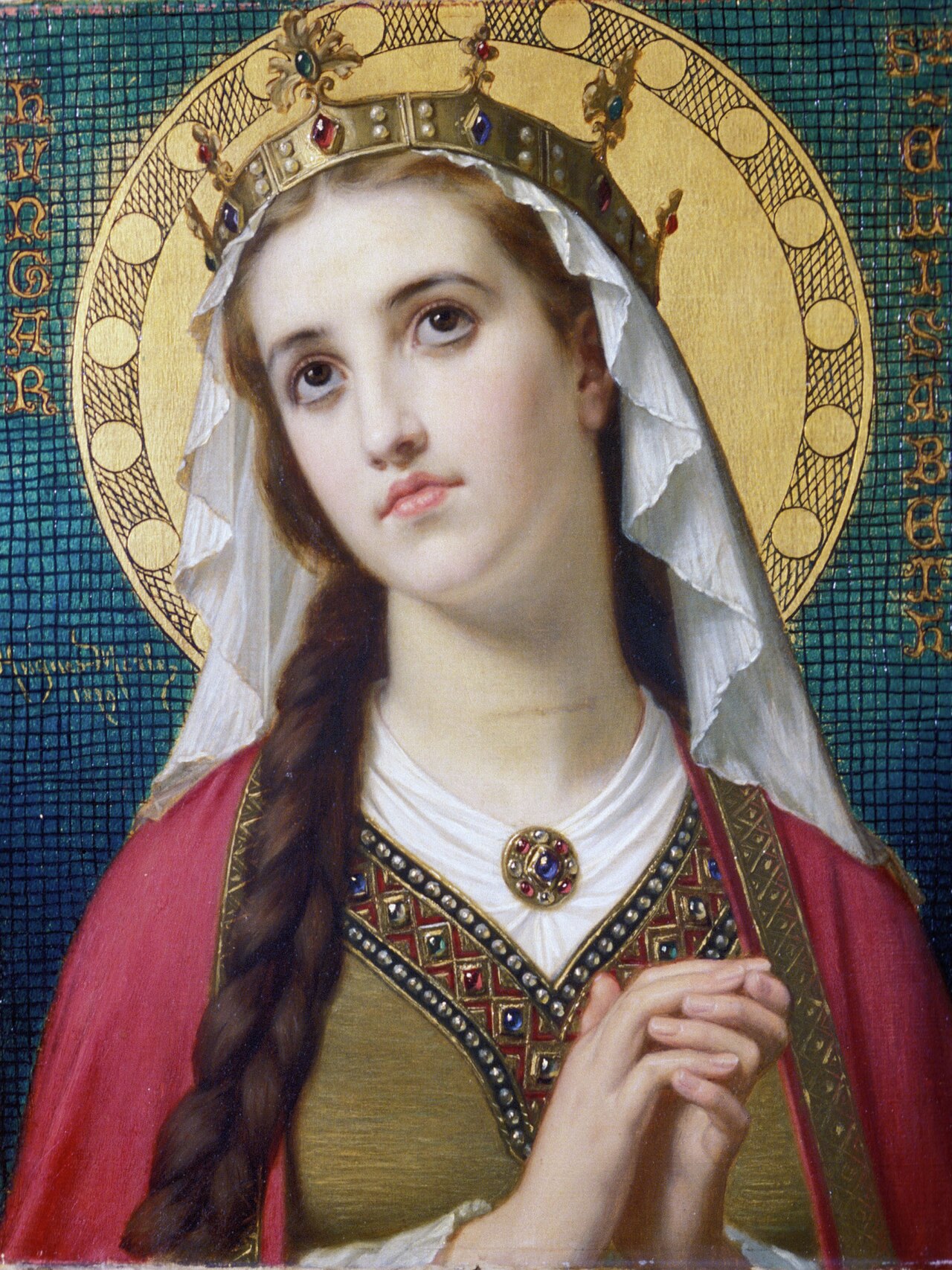
- Hugues Merle, Saint Elizabeth of Hungary, 1879. Detroit Institute of Arts. Public domain, via Wikimedia Commons. A later painting, not a portrait.